

Why Home Depot Keeps Announcing RTO
Plus, a co-working's comeback and the impact of RTO on federal employees

👋 Happy Tuesday! Home Depot is the latest Fortune 100 company to make headlines by telling employees that they need to be back in the office full-time. But as Henry O’Loughlin points out, this headline is a re-run: Home Depot made the same news back in January of 2025.
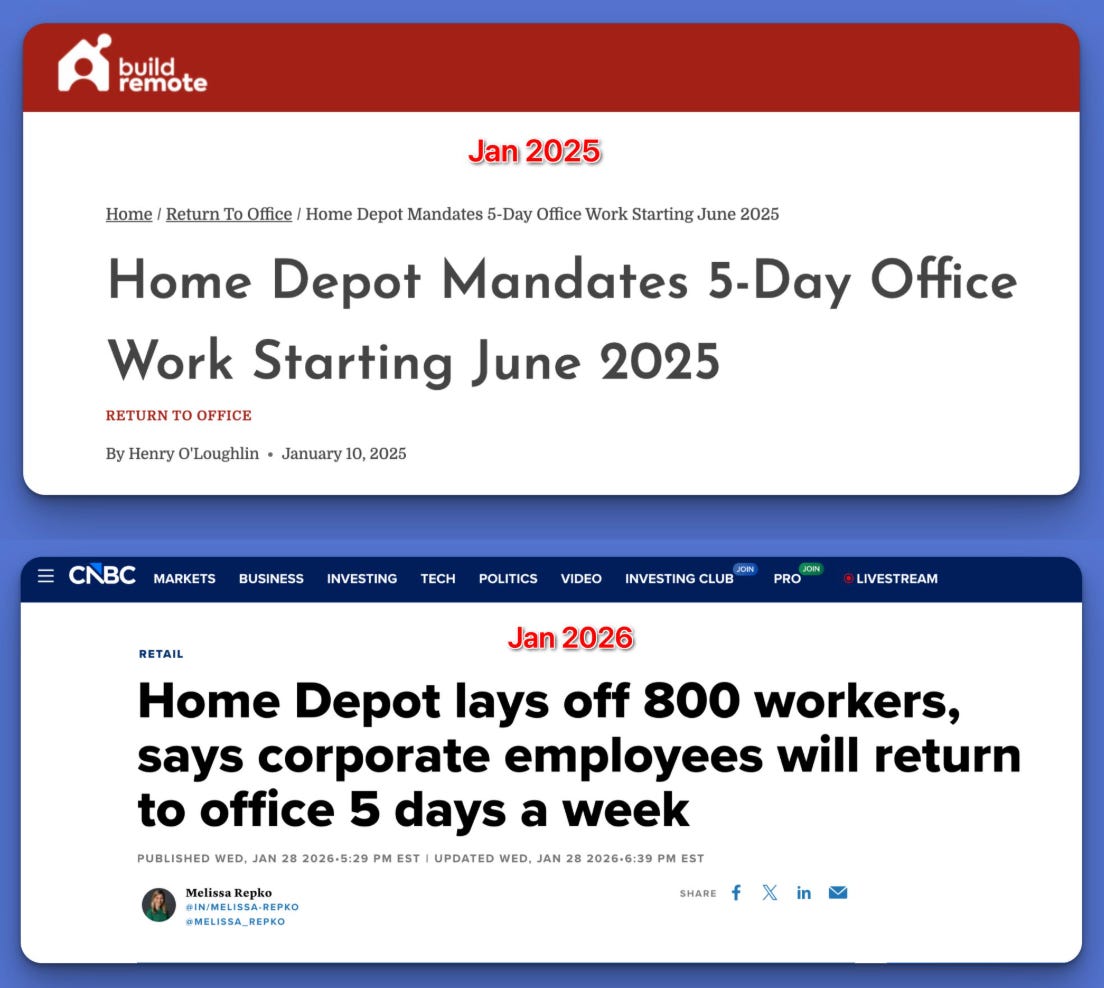
If at first you don’t succeed, try, try again? Home Depot isn’t alone in the re-run department: even two years ago, Stanford’s Nick Bloom had data showing that 17% of firms were on their third policy, not counting repeats.
In this week’s edition:
👩💻 Co-working Makes a Comeback
🗞️ Top Flexible Work News
🏛️ Federal RTO Backfires
Current Subscribers: 10,437
Please forward to colleagues and friends!
THIS WEEK’S FLEX FOCUS 🔍
Co-Working Makes a Comeback—But Not the Way You Remember It

Co-working is again one of the fastest-growing segments of the office market, but this time it’s not startups driving demand—it’s Pfizer, Amazon, JPMorgan Chase, Lyft, and Anthropic. U.S. shared office space has grown to 158.3 million square feet across nearly 8,800 locations, up from 115.6 million square feet across about 5,800 locations three years ago, according to data firm Yardi.
The shift reflects how some large companies are adapting to hybrid work. Rather than forcing long commutes to headquarters, they’re using co-working spaces to create satellite offices closer to where employees live, offering the same amenities workers get at HQ—collaboration space, mentoring opportunities, and food service—without the time and expense of daily downtown treks.
Single-site operators, not behemoths like WeWork, are fueling the growth. Independent operators have expanded 66% in the past three years to over 3,500 locations—double the growth rate of the top 20 operators. Yardi predicts flexible workspace could eventually reach 10% of U.S. office stock, up from 2.2% today, as 40-50% of companies say 20-30% of their portfolio will be flexible leases.
FLEX WORK QUICK HITS 💥
Stay ahead of the curve with our curated roundup of the trending flexible work stories making waves right now. Here's what you need to know 👇
HR Digest: Home Depot laid off 800 workers and mandated corporate employees return to the office five days per week starting April 6th. CEO Ted Decker says the changes are intended to increase “speed and agility” as the company deals with slower sales.
Forbes: Competition for remote jobs is intensifying as 2026 becomes the "era of selectiveness," with employers seeking cognitive flexibility, AI-assisted productivity, and cross-cultural collaboration as the global talent pool expands.
Business Insider: Automaker Stellantis mandates 5-day office return starting March 30, claiming the move will improve customer satisfaction and "strengthen culture of innovation," following Ford and Toyota's similar crackdowns on remote work.
FLEXPERT INSIGHTS 🧠
Government Data Shows What Happens When You Force RTO

A new Government Accountability Office report reveals the cost of President Trump’s January 2025 RTO mandate for federal agencies. At the Social Security Administration, telework hours plummeted from 35% to just 13% within months. By 2024, 37% of employees planned to leave within a year, with nearly half saying telework policies shaped that decision.
The irony? Agencies using hybrid schedules reported better recruitment and retention while sustaining performance—plus concrete savings like Treasury’s $1 million in facilities costs and EPA’s $7 million in avoided transit subsidies. Dr. Gleb Tsipursky, CEO of Disaster Avoidance Experts, argues that forcing the same schedule on every job drains the talent the public relies on. When the federal workforce stays whole, the public feels it first.
COMPANY SPOTLIGHT ✨
Sleep Number, established in 1987, is a U.S.-based company renowned for its innovative adjustable and smart beds designed to provide personalized comfort. Its mission is to improve lives by individualizing sleep experiences, with a vision of becoming the world’s most beloved brand by delivering an unparalleled sleep experience. The company operates across the U.S. with a headquarters in Minneapolis, Minnesota, and maintains numerous retail, outlet, and partner locations throughout the country.
Brilliant piece on the co-working shift. The point about how Pfizer and Amazon are useing these spaces as satellite offices to cut commute time is kinda genius when u think about it. I tried this at a previous role and the proximity factor legit made collaboration way smoother compared to endless zoom calls. Wild that single-site operators are driving growth, not the WeWork-type giants.