

Remote Work Unlocked the Productivity Boom
Plus, why office design is about to shift again.
👋 Happy Tuesday! For nearly five years, productivity growth has been unusually rapid. Everyone credits AI. But AI adoption only went mainstream around 2025—while the acceleration started three years earlier. Stanford economist Nick Bloom has a simpler explanation: remote work expanded the talent pool, letting companies match workers to jobs better. That better matching? That’s where the productivity came from. This week, we’re looking at what that means for how companies think about work.
In this week’s edition:
📈 Remote Work Didn't Cause the Productivity Boom. It Enabled It.
🗞️ Top Flexible Work News
🎥 Designing Work and Workplaces for the AI Era
Please forward to colleagues and friends!
THIS WEEK’S FLEX FOCUS 🔍
Remote Work Didn't Cause the Productivity Boom. It Enabled It.
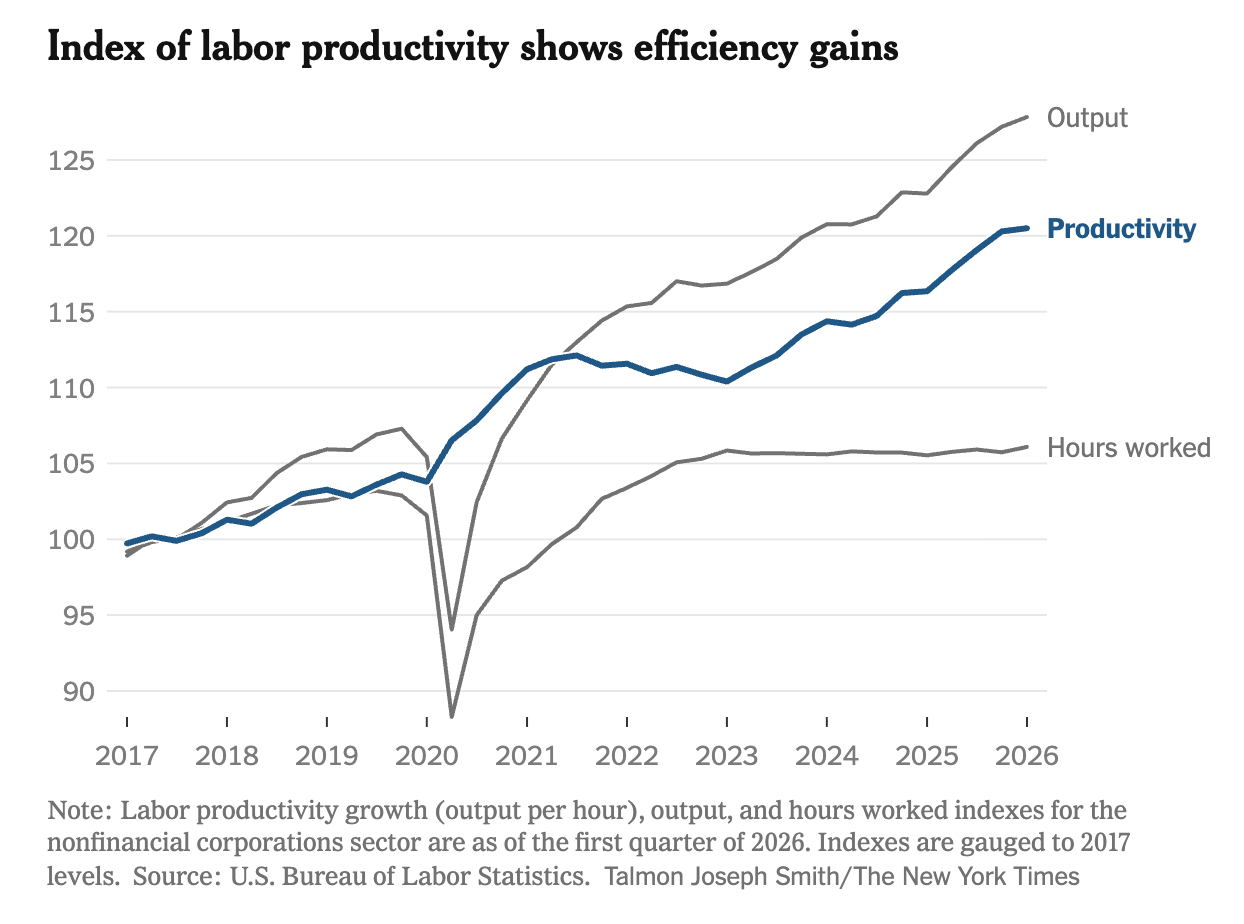
For nearly five years, productivity growth has accelerated. The obvious culprit: AI. But look at the timeline and you’ll find something else. AI adoption only went mainstream in 2025. The productivity acceleration started in 2020.
So what drove growth for the first three years? Remote work was one of the main factors:
“I believe the productivity gains began coming out of Covid with the digitization of work, remote work and the implementation of machine learning — and we’re just scratching the surface on A.I.” — KKR investment chief Henry McVey.
When companies went remote, they weren’t just letting people work from home. They were tapping into a bigger labor market. A developer in rural Montana could compete for a San Francisco job. A designer in Austin could work for a New York firm. Suddenly, companies could find better matches between workers and positions.
Better matching means higher productivity. A person in the right job produces more. Companies had been limiting themselves to local labor pools for decades. Remote work broke that constraint.
AI is coming next. Research finds firms report limited productivity gains from AI so far. But for the past three years, the story wasn’t about technology. It was about geography. If you’re still making people come to the office full-time, you’re competing in a smaller talent pool. You’re turning away better matches. And you’re leaving productivity on the table.
FLEX WORK QUICK HITS 💥
Stay ahead of the curve with our curated roundup of the trending flexible work stories making waves right now. Here's what you need to know 👇
Axios: After years of delays, San Francisco office-to-housing conversions are finally moving. Three projects totaling roughly 300 units expect to submit applications this month, fueled by tax incentives and streamlined approvals
HR Dive: A U.S. Court of Appeals ruled employers can deny remote work as a disability accommodation if being on-site is essential—even if the employee worked from home during the pandemic.
Business Insider: Robin CEO on what’s ahead: AI is creating demand for quiet spaces (for talking to AI agents) and collaborative pods (for cross-functional teams).
FLEXPERT INSIGHTS 🧠
Built for People: Designing Work and Workplaces for the AI Era
AI is rewriting how work gets done. And the organizations pulling ahead are treating it as a people transformation, not a technology rollout.
That puts HR, leadership, and the workplace itself at the center. In this webinar, Laura Adams (Chief Human Resources Officer, JLL), Debbie Lovich (Senior Partner, BCG), Iain Roberts (Senior Advisor, Airbnb), and Brian Elliott (Charter) explored how to redesign both the work—roles, processes, teams in an AI-enabled world—and the workplaces that bring people together to learn, collaborate, and belong.
The research is clear: employee joy and engagement link directly to measurable business outcomes. And right now, most companies are redesigning work without redesigning the physical spaces where that work happens. That’s the gap.
This is the kind of conversation that shapes how we think about work: real leaders talking about what’s working, what’s not, and what comes next—no pretense, no performance.