


👋 Happy Tuesday! We’ve got some big news for fans of flexible work data!
In this week’s edition:
📣 Big News about Flex Index Data!
🗞️ Top Flexible Work News
🩹 Duct Tape and Favors
Please forward to colleagues and friends!
THIS WEEK’S FLEX FOCUS 🔍
Free the Data, Part Two
Hi, Brian here! A year ago, over at Work Forward, I wrote that the best ideas spread through networks not paywalls, and made the Flex Index free.
That solved the price, but it ignored a much harder problem. I’d taken on the Flex Index to make sure it stayed alive, but a dataset that lives inside a company, including mine, is only as durable as that company’s priorities and resources. I’ve been working hard on a broader set of leadership issues, including a new venture with my friends at Charter that we’ll announce next week. In the meantime, as some of you noticed, Flex Index hasn’t produced a new report this year. That sucks.
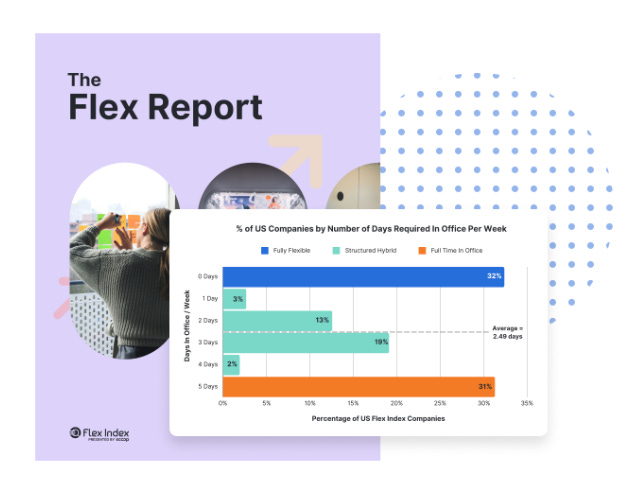
So here’s the news: Stewardship of the Flex Index data is moving to Professor Prithwiraj (Raj) Choudhury at the London School of Economics, working with Assistant Professor Marco Minervini at IE University in Madrid. It becomes an open research repository, hosted by a university, free for good.
Raj and I have worked together since the early days of the pandemic. He did webinars for Future Forum, I interviewed him about his book, and Raj, Nick Bloom and I wrote Hybrid Work Is Not the Problem, Poor Leadership Is. To me, that title defined the problem with most of the debates around remote work and RTO: the surface-level policy solutions that ignore the more fundamental opportunities to improve work for people and organizations.
The reason I’m excited to put the future of the Flex Index data into Raj and Marco’s hands is that I know they care about the topic, and they’re not swayed by commercial interests. Almost every well-funded source of data on flexible work is produced by someone with a position to defend. Landlords, brokerages, badge-swipe vendors, consultancies with a hybrid practice to sell. The Flex Index exists because leaders needed somewhere to go when the headline screamed “Big Company Demands Everyone Back!” and they wanted to ask whether that was actually true.
Raj is excited too:
“The team and I are thrilled to be taking on the Flex Index, and grateful to Brian for his support along the way. We have spent years arguing about flexible work using incompatible datasets, most of them proprietary and many of them built by organizations with a stake in the answer. Putting the Flex Index in the open, inside a university, means the next five years of that argument can be settled with evidence that anyone can check, replicate, and build on.”
What everyone gets out of this
The underlying data, not just the reports. Until now you waited for a quarterly PDF and got whichever cut of the data we chose to publish. The LSE and IE team is putting the dataset itself into a public repository, continuously accessible, with gaps backfilled using historical job-posting data and refreshes landing twice a year. If you have ever wanted to run your own industry cut, build your own comparison set, or check a claim against the underlying rows, you can now do that without asking anyone’s permission. Or hoping that I have the file, which I’m notoriously bad at finding.
The methodology is worth a line: AI-enabled and human-based classification across job postings, corporate sites, press releases, and media coverage, with verification by trained humans. It’s been a labor of love for a few of us over the years, and we’re glad it’s finding a good home!
Additional dimensions. The Flex Index has always measured where people work. The team is extending into other elements of employee experience, including topics such as schedule flexibility. This is also part of a broader set of forums for the conversation about workplace flexibility to thrive in the months and years to come.
What changes, and when
The current Flex Index site will be reduced in functionality in the weeks to come. Everything at flexindex.com/reports today, the full historical archive of quarterly and industry reports, will move to the LSE Flex Index page. We’ll also mirror the archive on Work Forward.
The first refresh under the new team lands on or before October 6th, timed to the Remote & Distributed Research Initiative at LSE.
Where the conversation goes next
That October 6th event is an international mini-conference at London School of Economics, run with the newly formed Remote Work Institute, which Raj co-chairs with Tulsa Remote’s Justin Harlan. The Institute is funding five research projects at up to $15,000 each, with working papers due within a year, all of it aimed at the parts of the remote work question that current research hasn’t answered well. Attendance will hybrid, so you can join from anywhere—stay tuned for how to sign up!
But, what about this newsletter?
The Flex Index newsletter keeps arriving weekly. We’ll keep covering the most notable research and insights on workplace flexibility, and we’re extending the coverage further. More on that soon.
The best data on how work is changing should belong to everyone studying it, not to whoever happens to own it this year. That was the argument for making the Flex Index free, and it’s the same reason that academic ownership is the best next step!
FLEX WORK QUICK HITS 💥
Stay ahead of the curve with our curated roundup of the trending flexible work stories making waves right now. Here's what you need to know 👇
The Guardian: Airbus has backed off plans to cut remote work to one day a week after months of strikes in Spain, France, and the UK.
HR Dive: Across 7,700 responses, remote workers reported the highest well-being, connection held steady regardless of location, and well-being predicted retention better than proximity.
The Hill: A new model puts the value of flexible work at 56% of a programmer’s salary, counting the recovered hours and avoided costs that never reach a paycheck.
FLEXPERT INSIGHTS 🧠
Duct Tape and Favors
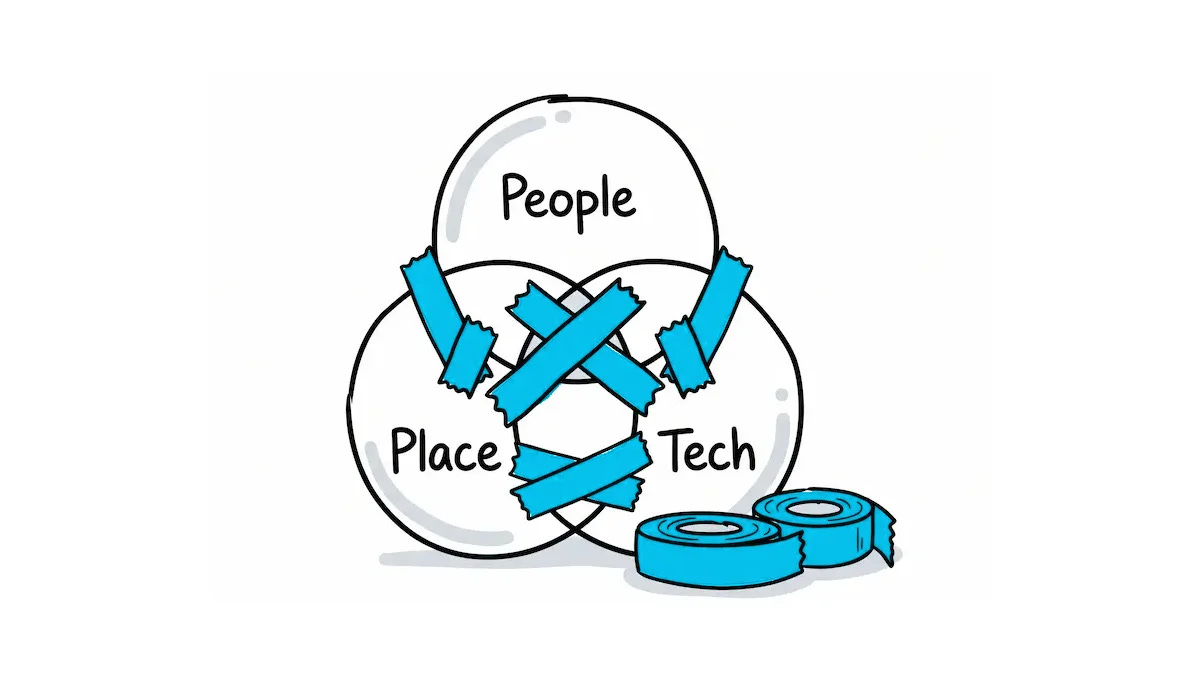
Your hybrid policy has an owner. On most org charts it’s the head of corporate real estate and workplace strategy, who reports to the CFO. The experience of that policy belongs to someone else in HR under the CHRO, and the digital friction belongs to a third person in IT. Nobody owns all three.
Phil Kirschner calls the people stranded in those seams misfits, and his test is simple: you own the outcome, someone else owns the resources. That’s anyone accountable for how hybrid actually feels while the budget, the headcount, and the buildings answer to a different chief. They hold it together on borrowed authority, and when they leave, the gap closes behind them.
Brian, Congrats on the new strategy here. Certainly makes sense to move the data into a university-based environment for all the reasons you outline. And Raj Choudhury is the perfect candidate to maintain the integrity and utility of the data. Good luck Raj!
Looking back now on 6 years of the post-pandemic evolution in work and the workplace, it appears that interest in the issue of where and how work should be performed has fallen considerably in light of the impact of Generative AI, and now Agentic AI, as the ultimate driver of work and the workplace.
We really won't know where we are headed on both topics until the agentic component takes hold and we see the impact across a wide segment of businesses. But enough is underway to suggest that within a year or two, the fog will lift sufficiently again to make more accurate projections of where we are headed on both topics.
Thanks for all that you have done and continue to do to inform all interested in this component of business life.